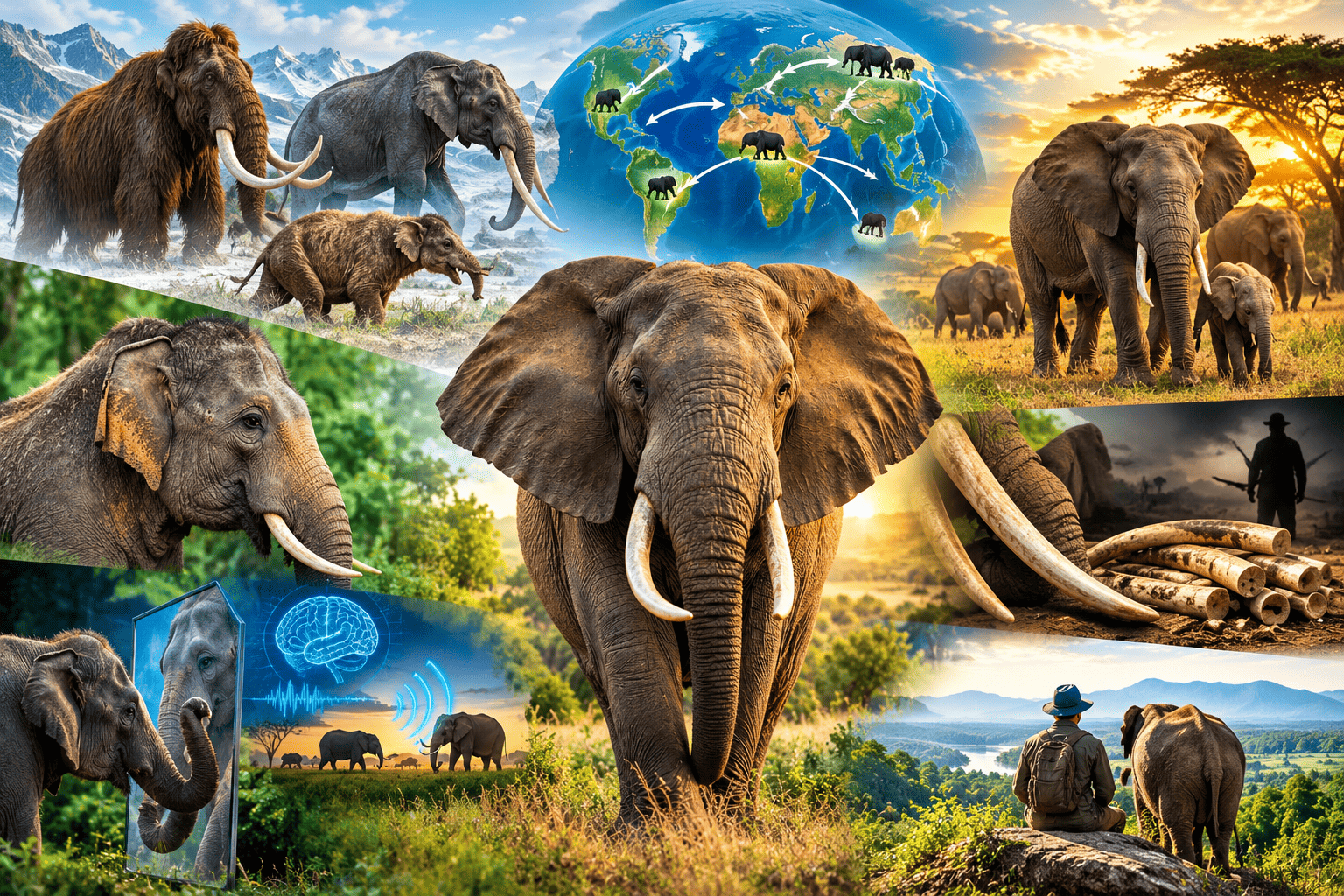
Elephants: Millions of Years of Evolution, Extraordinary Intelligence, and the Human Threat to Their Survival
Elephants: Millions of Years of Evolution, Extraordinary Intelligence, and the Human Threat to Their Survival
Subtitle: From ancient giants that crossed continents to modern elephants fighting for survival, discover the remarkable history, intelligence, and conservation challenges of one of Earth’s most extraordinary animals.
Introduction: A Legacy Older Than Human Civilization
Elephants are among the most remarkable animals on our planet. Their enormous bodies, exceptional memories, complex social relationships, and impressive intelligence have fascinated humans for centuries. Yet, behind their majestic appearance lies a story of millions of years of evolution, survival, adaptation, and, increasingly, human-caused suffering.
Long before modern human civilizations emerged, the ancestors of elephants were already adapting to changing landscapes, climates, and ecosystems. Over millions of years, their descendants developed powerful bodies, elongated trunks, specialized teeth, and social structures that helped them survive in different environments across Africa, Europe, Asia, and North America.
Today, however, these magnificent animals face a new and dangerous challenge. Ivory poaching, habitat destruction, human-elephant conflict, and the effects of environmental change threaten their future.
Perhaps the most disturbing part of this story is that human activities have influenced not only elephant populations but also their evolution.
Understanding the history of elephants helps us recognize an important truth: these animals are not simply symbols of strength, tradition, or beauty. They are living beings with complex needs, remarkable abilities, and an evolutionary history that deserves our respect.
1. The Extraordinary Intelligence of Elephants
Elephants are known for their impressive cognitive abilities. They demonstrate advanced social behaviour, long-term memory, problem-solving skills, and sophisticated communication.
One particularly interesting area of research concerns mirror self-recognition. Scientists have investigated whether certain animals can recognize themselves in a mirror rather than interpreting the reflection as another individual.
Elephants are among the animals that have demonstrated evidence of mirror self-recognition in experimental studies. Other animals studied in this context include dolphins, chimpanzees, and magpies. However, mirror tests measure only one aspect of cognition and should not be treated as a complete measure of animal intelligence.
Elephants also display behaviours associated with social awareness and emotional complexity. They maintain relationships within family groups, respond to the needs of other members, and can show sustained interest in the remains of other elephants.
Their intelligence is particularly important in the wild, where survival often depends on remembering water sources, recognizing threats, navigating familiar routes, and learning from experienced members of the herd.
For elephants, memory is not merely an impressive ability. It can be essential to survival.
2. Tusks: More Than a Symbol of Strength
An elephant’s tusks are among its most recognizable features. These elongated teeth play important roles in everyday life, helping elephants dig for water, remove bark from trees, manipulate objects, and defend themselves.
Tusks are also closely associated with ivory, a material that has been valued and traded by humans for centuries.
However, tusk development differs between elephant species.
In African elephants, both males and females commonly develop tusks, although some individuals are naturally tuskless. In Asian elephants, tusks are generally much more prominent in males, while females usually have small or inconspicuous tushes rather than large tusks. Some Asian males also lack visible tusks.
These differences reflect the evolutionary history and genetics of the respective populations.
For an elephant, tusks are useful biological tools. For humans involved in the illegal ivory trade, they have become a reason to kill.
This conflict between the biological purpose of tusks and their commercial value has created devastating consequences for elephant populations.
3. When Poaching Begins to Change Evolution
One of the most striking examples of human influence on elephant evolution has emerged from research in Gorongosa National Park, Mozambique.
During the Mozambican Civil War, from 1977 to 1992, intense ivory poaching caused a dramatic decline in the local elephant population. Elephants with tusks were more likely to be targeted, meaning that tuskless individuals had a greater chance of surviving and reproducing.
Researchers subsequently documented an increased frequency of tusklessness among female African savanna elephants in the affected population. A 2021 study published in the journal Science found evidence that intense poaching had driven rapid evolutionary change, with genetic factors associated with tusk development playing an important role. Source: Campbell-Staton et al., 2021.
This finding reveals something deeply troubling: human exploitation can influence which inherited characteristics become more common in a wild population.
However, it is important to understand the scientific explanation correctly. Elephants do not consciously decide to be born without tusks because they understand that ivory hunters are dangerous. Instead, natural selection can favour inherited traits that improve survival under particular conditions.
When tusked elephants are disproportionately killed, tuskless individuals may survive and reproduce at higher rates. Over generations, this can increase the frequency of tusklessness within the population.
This is evolution responding to human pressure.
Tusks remain valuable tools for elephants, so their loss can also carry costs. Elephants without tusks may face difficulties performing certain tasks, including digging and stripping bark, depending on their environment and circumstances.
The lesson is clear: wildlife exploitation can alter the evolutionary future of a species, not simply reduce the number of animals alive today.
4. The Ancient Origins of Elephants
The evolutionary history of elephants stretches back tens of millions of years.
Their ancestors belonged to a much broader group of mammals that included numerous extinct forms. Over geological time, different lineages developed distinctive body shapes, teeth, tusks, and feeding adaptations.
The modern elephant family, Elephantidae, represents only one surviving branch of this much larger evolutionary history.
Scientists study fossil remains to understand how these animals changed and how their different lineages were related. Some extinct relatives were relatively small, while others developed enormous bodies and unusual tusk arrangements.
It is important to remember that not every extinct animal discussed in the history of elephants was a direct ancestor of modern elephants. Many were related evolutionary branches that developed different adaptations and eventually disappeared.
Nevertheless, their fossils reveal how diverse the elephant family and its relatives once were.
Pangaea and the changing continents
Earth’s continents have changed dramatically over geological time. The supercontinent Pangaea existed roughly 335 to 175 million years ago, although its assembly and breakup occurred over extended periods.
The ancestors of elephants evolved much later, so modern elephant evolution did not occur on an intact Pangaea. Instead, the movement of continents and the changing distribution of land, climate, and vegetation helped shape the environments in which mammals evolved.
Over millions of years, elephant relatives spread across parts of Africa, Eurasia, and eventually North America. Their distribution was influenced by changing landscapes, land connections, and environmental conditions.
These migrations demonstrate the remarkable ability of some ancient mammal lineages to expand into new habitats.
5. Ancient Elephant Relatives: A World of Diversity
The fossil record contains a fascinating variety of animals related to the elephant lineage. Their differences help scientists understand the evolutionary experiments that occurred long before the appearance of today’s elephants.
Moeritherium
<text></text>
Moeritherium lived during the Eocene, approximately 37–35 million years ago, in what is now northern Africa. It was much smaller than modern elephants and had a relatively short body and distinctive teeth.
It did not possess the enormous trunk and familiar appearance of modern elephants. Although it is often discussed in accounts of elephant evolution, it should not be described as a proven direct ancestor of living elephants.
Deinotherium
Deinotherium was a large extinct proboscidean distinguished by tusks that curved downward from its lower jaw.
These unusual tusks made it one of the most recognizable ancient relatives of elephants. Different species of Deinotherium lived across parts of Africa and Eurasia over millions of years.
Its anatomy demonstrates how differently tusks could develop among ancient members of the broader elephant lineage.
Gomphotheres
Gomphotheres were a diverse group of extinct proboscideans, many of which possessed four tusks: two in the upper jaw and two in the lower jaw.
Some species had elongated lower jaws and flattened lower tusks that may have helped them gather or process vegetation.
Gomphotheres spread across several continents, including parts of Africa, Eurasia, and the Americas. Their diversity illustrates the variety of feeding strategies that evolved among ancient proboscideans.
Stegodon
Stegodon was another extinct proboscidean genus with long, often impressive tusks. Different species lived across parts of Asia and nearby regions.
Some Stegodon species survived until relatively recent prehistoric times, and remains have been found on islands where isolated populations evolved in distinctive ways.
Their history helps researchers investigate how geography and environmental change affected large mammals.
Mastodons
Mastodons were extinct proboscideans that lived in parts of North America and other regions. They were related to elephants but belonged to a different evolutionary lineage from modern elephants.
Many mastodons had robust bodies and teeth adapted for browsing on leaves, twigs, and other vegetation.
Their fossils reveal how ancient proboscideans occupied different ecological roles in environments that changed repeatedly over time.
Mammoths
Mammoths are among the best-known extinct relatives of modern elephants. Woolly mammoths developed dense fur, layers of insulating fat, and other adaptations that helped them survive in cold environments.
Their range extended across parts of northern Eurasia and North America. Other mammoth species occupied different habitats and climates.
Woolly mammoths survived in some isolated locations until approximately 4,000 years ago, long after most mainland populations had disappeared.
Their extinction was likely influenced by a combination of climatic and environmental changes and human hunting, although the relative importance of these factors varied among populations.
Straight-tusked elephants
Straight-tusked elephants, including Palaeoloxodon antiquus, were large extinct proboscideans that lived across parts of Europe and western Asia.
They inhabited a variety of environments during the Pleistocene. Their remains provide evidence of the wide geographical distribution and ecological diversity of ancient elephant relatives.
Some members of the broader Palaeoloxodon lineage also reached islands, where isolated populations evolved into much smaller forms.
6. Island Dwarfism: How Giants Became Small
One of the most fascinating examples of evolutionary adaptation occurred on Mediterranean islands.
The extinct species Palaeoloxodon falconeri, associated with Sicily and Malta, was dramatically smaller than its large mainland relatives. Adults stood at approximately one metre at the shoulder, although estimates vary.
How could an animal related to enormous elephants become so small?
One explanation is a phenomenon known as island dwarfism.
Islands often have limited food resources and restricted living space. For large mammals, smaller body sizes can sometimes offer advantages because they require fewer resources.
Over many generations, natural selection can favour smaller individuals in isolated populations. The process is not a conscious response to the island’s size; it is a gradual evolutionary change shaped by inherited variation and environmental pressures.
Island dwarfism has occurred in several groups of mammals, making ancient Mediterranean elephants an especially compelling example of how evolution can produce very different body sizes within related lineages.
7. How Elephants Spread Across Continents
Elephant relatives once occupied a much wider geographical range than their modern descendants.
Fossil evidence shows that proboscideans spread across Africa, Europe, Asia, and North America. Some lineages also reached South America after the formation of the Isthmus of Panama created a land connection between North and South America.
During periods when global temperatures were lower, sea levels fell and exposed land bridges connected regions that are separated by water today.
One important example was the Bering land connection between northeastern Asia and northwestern North America, which enabled animals to move between the continents during suitable periods.
These movements were not one single migration by one elephant species. Different lineages spread at different times, and their ranges changed as climate, vegetation, and geography changed.
Modern elephants now occupy a much smaller range, primarily in sub-Saharan Africa and parts of South and Southeast Asia.
Their reduced distribution is a reminder that the presence of a species across the world today does not necessarily reflect the full extent of its evolutionary history.
8. The Extraordinary Social Life of Elephants
Elephants are not merely large animals living independently in the wild. They are highly social mammals whose survival often depends on cooperation, learning, and communication.
Many elephant herds are organized around experienced females known as matriarchs. These individuals can help guide their groups through familiar landscapes, identify potential dangers, and locate resources.
Older elephants may retain knowledge of routes and water sources that younger members have not yet encountered. During difficult seasons, such knowledge can be especially valuable.
Elephants also communicate through a combination of vocalizations, body movements, touch, scent, and low-frequency sounds.
Some of these sounds fall below the lower limit of normal human hearing. These low-frequency calls can travel long distances under suitable conditions and help elephants coordinate their behaviour.
Elephants also produce ground vibrations through movement and other activities. Research has investigated how elephants detect seismic signals through their feet and other sensitive structures.
However, the exact distances over which particular signals can be detected depend on environmental conditions, the type of signal, and the sensitivity of the receiving animal.
Communication and avoiding conflict
Elephants do not simply rely on physical strength when encountering other groups. Their social behaviour includes signals that convey information about identity, reproductive status, emotional state, and potential threats.
These communication systems can help individuals assess situations before deciding how to respond.
Their social intelligence and ability to learn from experience are among the qualities that make elephants so remarkable.
Protecting elephants therefore means preserving more than individual animals. It also means protecting family groups, social relationships, movement routes, and the environments in which knowledge is passed between generations.
9. African Elephants and Asian Elephants
Modern elephants belong to two living genera: Loxodonta, which includes African elephants, and Elephas, which includes the Asian elephant.
African savanna elephants and African forest elephants are recognized as distinct species by many contemporary scientific authorities. Asian elephants belong to a separate species, Elephas maximus.
African savanna elephants generally inhabit open savannas and a variety of other landscapes, while African forest elephants are associated with the forests of central and western Africa.
Asian elephants occur across parts of South and Southeast Asia, including Sri Lanka, India, Nepal, Thailand, and other countries.
Although these elephants share a common evolutionary heritage, they differ in body shape, habitat use, distribution, and other characteristics.
Asian elephants generally have smaller ears than African savanna elephants. Tusk development also differs between the groups, particularly among females.
All living elephant species are threatened by a combination of habitat loss, human-elephant conflict, and other human pressures, although the nature and severity of these threats vary by region.
10. The Plight of Elephants in Sri Lanka
Sri Lanka has a particularly strong cultural and ecological connection with Asian elephants.
The Sri Lankan elephant, Elephas maximus maximus, is a recognized subspecies of the Asian elephant. Wild elephants are an important part of the country’s natural heritage and contribute to the functioning of its ecosystems.
However, elephants in Sri Lanka face serious challenges as human settlements, agriculture, roads, and other forms of development affect their habitats and movement routes.
Human-elephant conflict can lead to the loss of human lives, damage to crops and property, and the deaths of elephants. It is a complex problem that requires practical, locally appropriate conservation measures.
Protecting elephant habitats and migration corridors is important because elephants need access to food, water, breeding opportunities, and seasonal resources across large landscapes.
Conservation must also consider the safety and livelihoods of rural communities. Measures that protect both people and elephants are more likely to produce lasting results than approaches that ignore either side of the problem.
Sri Lanka’s elephant conservation efforts therefore need to combine habitat protection, responsible land-use planning, effective wildlife management, community participation, and continued scientific research.
Tradition and animal welfare
Elephants have long been associated with Sri Lankan culture, religious ceremonies, and historical traditions. They also appear in art, literature, and national imagery.
Cultural significance, however, should not remove the need to consider the welfare of individual animals.
Whenever elephants are used in public ceremonies, tourism, or other human activities, their physical condition, social needs, working conditions, and access to appropriate care deserve careful attention.
Respect for elephants should include both appreciation of their cultural significance and a commitment to protecting their welfare.
11. Ivory Poaching: A Human-Created Crisis
Ivory poaching is one of the clearest examples of human activity threatening elephants because of a specific physical characteristic.
Elephants are killed for their tusks, which enter illegal or poorly regulated markets. This pressure can reduce populations, disrupt family structures, and influence the inherited characteristics of surviving animals.
A major analysis published in 2024 examined African elephant population trends across 475 survey sites in 37 countries between 1964 and 2016. The study reported substantial declines at many sites, with poaching and habitat loss among the major pressures. The results also showed that trends differed between regions, demonstrating the importance of effective conservation and management. Source: Reuters’ report on the 2024 study.
The scale of these declines demonstrates that elephant conservation cannot depend on admiration alone. It requires effective action against illegal wildlife trade, protection of habitats, responsible management, and cooperation between countries.
The demand for ivory is especially damaging because it gives elephants’ tusks a commercial value that can outweigh the value of keeping the living animal alive in the eyes of poachers and criminal networks.
Reducing this demand and enforcing wildlife protection laws are essential steps towards safeguarding elephant populations.
12. Can Elephants Survive the Future?
Elephants have survived dramatic changes in climate, vegetation, and geography over millions of years. Their ancestors occupied a remarkable variety of environments, and different lineages developed adaptations that enabled them to survive for long periods.
Yet, evolutionary success does not make a species invulnerable.
Modern environmental change can occur alongside habitat fragmentation, illegal hunting, expanding human settlements, and other pressures. These threats may interact in ways that make survival more difficult.
Elephants reproduce relatively slowly compared with many smaller mammals. As a result, severe population losses can take a long time to reverse.
Their large size and complex social structures also mean that protecting elephants requires more than safeguarding a few isolated animals. Conservation programmes need to preserve sufficient habitat, maintain movement corridors, protect family groups, and reduce preventable deaths.
The future of elephants will depend significantly on human choices.
Governments, conservation organizations, local communities, researchers, businesses, and individual citizens all have roles to play.
Supporting responsible wildlife tourism, respecting protected habitats, refusing ivory products, reporting wildlife crime where safe and appropriate, and supporting credible conservation programmes are practical ways to contribute.
Conclusion: What Does Our Treatment of Elephants Say About Us?
Elephants have an evolutionary history stretching back tens of millions of years. Their ancestors survived changing continents, shifting climates, and the disappearance of many other animal lineages.
They developed powerful bodies, versatile trunks, specialized tusks, complex communication systems, and social relationships that help them navigate difficult environments.
Today, these extraordinary animals face dangers created or intensified by human activity.
The increase in tusklessness observed in some heavily poached African elephant populations is a particularly powerful warning. It shows how human actions can change the evolutionary direction of a species within a relatively short period.
But elephants should not have to lose their tusks, their habitats, or their lives to survive alongside us.
A truly respectful relationship with wildlife requires us to recognize that animals have value beyond their usefulness to humans, their appearance, or their place in cultural traditions.
Elephants are not simply symbols of power and majesty. They are living, intelligent mammals with their own needs and social worlds.
We still have an opportunity to protect them. The question is whether we will choose to do so before more of these magnificent giants disappear from the landscapes they have inhabited for generations.
Protecting elephants is not only about preserving the past. It is about deciding what kind of future we want to share with the natural world.