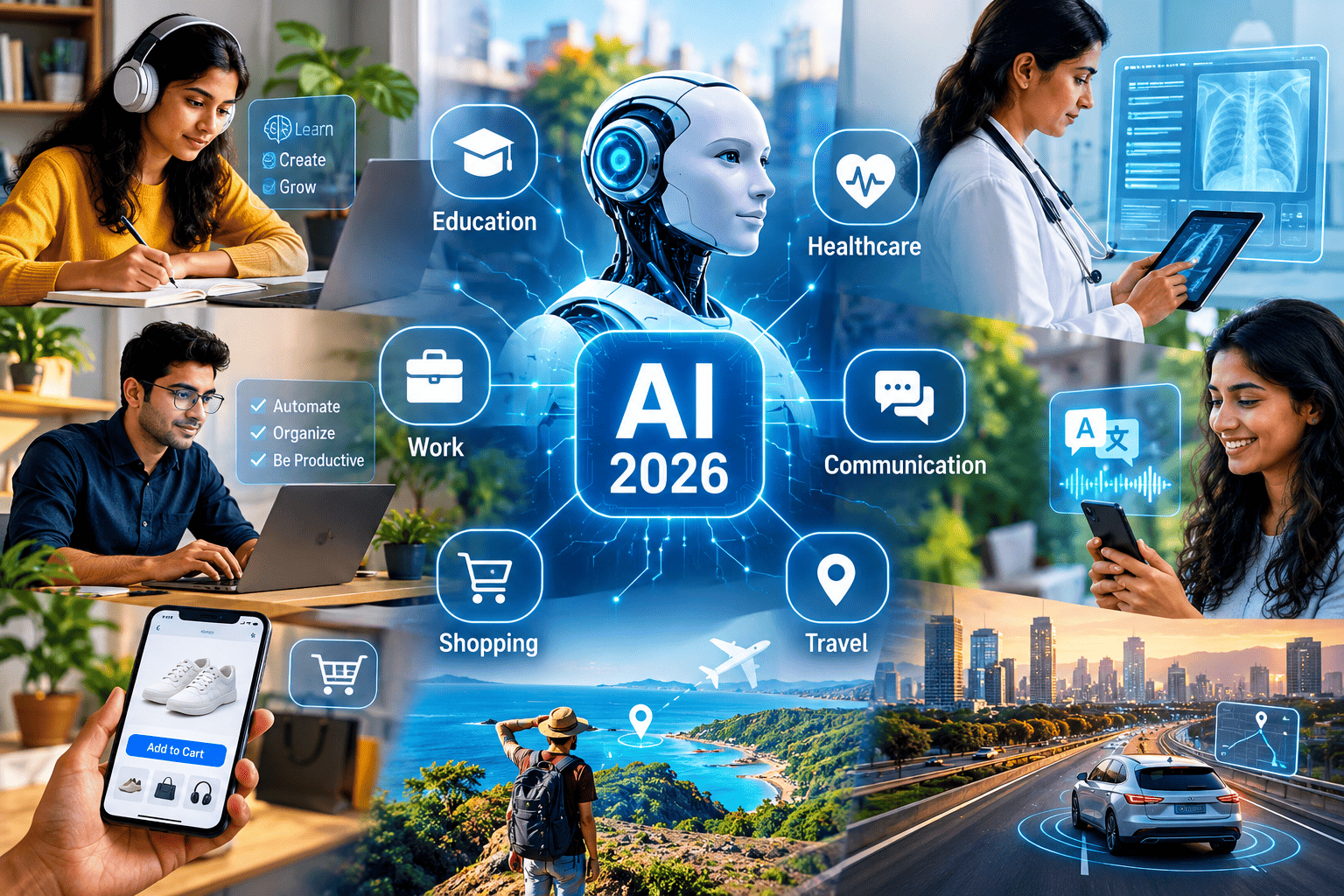
How Artificial Intelligence Is Changing Everyday Life in 2026
How Artificial Intelligence Is Changing Everyday Life in 2026
Artificial intelligence is no longer just a futuristic concept found in science fiction movies. In 2026, AI-powered tools are becoming increasingly common in the way people work, study, communicate, shop, and manage everyday activities. From virtual assistants and personalized recommendations to AI writing tools and intelligent navigation systems, this technology is influencing many aspects of modern life.
The rapid development of artificial intelligence has created new opportunities for individuals, businesses, educators, and researchers. At the same time, it has raised important questions about privacy, employment, misinformation, and the responsible use of technology.
According to Stanford University’s 2026 AI Index Report, generative AI reached approximately 53% population-level adoption within three years of its emergence, although adoption varies significantly across countries. The report highlights how quickly AI tools have spread and how their influence on society continues to grow.
As artificial intelligence becomes more accessible, understanding how it works and how to use it responsibly is becoming an important digital skill.
In this article, we explore how artificial intelligence in 2026 is changing everyday life, its major benefits, the challenges people should understand, and what the future may hold.
What Is Artificial Intelligence?
Artificial intelligence, commonly known as AI, refers to computer systems designed to perform tasks that typically require human-like cognitive abilities. These tasks can include recognizing patterns, understanding language, analyzing information, generating content, and supporting decision-making.
AI systems use different techniques, including machine learning, deep learning, natural language processing, and computer vision.
For example, a navigation application may use AI-related techniques to estimate travel times and suggest routes. An email service may identify suspicious messages, while a generative AI assistant can help draft a report, explain a complicated concept, or summarize a long document.
What Is Generative AI?
Generative AI is a type of artificial intelligence that creates new content based on patterns learned from training data. Depending on the system, it can generate text, images, computer code, audio, video, and other forms of content.
Popular uses include:
- Writing and editing articles, emails, and reports.
- Creating images and brainstorming design ideas.
- Explaining educational concepts.
- Assisting with programming and troubleshooting.
- Summarizing documents and organizing information.
However, generative AI does not automatically understand every subject correctly. Its responses can contain inaccurate information, misleading explanations, or invented details. Human review remains essential.
1. Artificial Intelligence Is Transforming Education
Education is one of the areas where AI can make a practical difference. Students can use AI-powered tools to understand difficult topics, practice languages, organize revision schedules, and receive explanations tailored to their learning needs.
Instead of searching through multiple resources to understand a complicated concept, a student can ask an AI assistant to explain it in simpler language or provide examples.
Personalized Learning for Students
AI tools can support personalized learning by adjusting explanations, exercises, and feedback to suit an individual’s needs.
For example, a student learning mathematics could request a step-by-step explanation of an equation. Someone studying English could practice grammar, improve sentence structure, or receive feedback on a draft.
AI can also help learners:
- Create revision notes from study materials.
- Generate practice questions and quizzes.
- Summarize lengthy reading materials.
- Develop study plans for upcoming examinations.
- Practice conversations in different languages.
These tools are most effective when students use them to improve understanding rather than simply copying answers.
How Teachers Can Benefit From AI
Teachers can use AI to develop lesson outlines, create practice activities, generate examples, and adapt educational materials for different learning levels.
Nevertheless, AI-generated material should be reviewed for accuracy, relevance, bias, and age appropriateness. Students and teachers should also follow their institution’s academic integrity rules.
UNESCO’s guidance on generative AI in education emphasizes a human-centered approach that considers privacy, educational suitability, ethics, and the role of teachers.
2. AI Is Changing the Way People Work
Artificial intelligence is increasingly being used to support everyday workplace activities. Many tasks that involve organizing information, drafting content, analyzing data, or handling repetitive processes can potentially be completed more efficiently with AI assistance.
Automating Repetitive Tasks
Businesses can use AI-powered systems to classify customer inquiries, summarize meetings, prepare initial reports, organize documents, and assist with routine administrative work.
For example, a small business owner might use an AI assistant to prepare a first draft of a customer email, generate ideas for a marketing campaign, or summarize customer feedback.
A software developer may use AI coding tools to explain unfamiliar code, identify possible errors, or suggest improvements. A researcher might use AI to organize notes and identify questions for further investigation.
These applications can save time, but the actual benefits depend on the task, the quality of the system, and how carefully its output is reviewed.
Will AI Replace Human Jobs?
The effect of AI on employment is complex. Some tasks may become automated, certain jobs may change significantly, and new opportunities may emerge in AI development, data analysis, cybersecurity, digital services, and other fields.
It is important to distinguish between automating a task and replacing an entire job. Many occupations combine technical knowledge, communication, judgment, creativity, and responsibility.
Workers can prepare for changes by developing skills that complement AI, including:
- Critical thinking and problem-solving.
- Communication and collaboration.
- Digital literacy and AI literacy.
- Creative thinking and adaptability.
- Subject-specific expertise and professional judgment.
Rather than assuming that every job will disappear, individuals should focus on understanding how AI may change the tasks involved in their chosen careers.
3. Artificial Intelligence Is Influencing Healthcare
AI is being explored and used in healthcare for tasks such as medical image analysis, clinical documentation, research, patient scheduling, and decision support.
These applications may help healthcare professionals process information and manage certain workflows. However, their effectiveness depends on the specific system, clinical setting, available data, and appropriate professional oversight.
Supporting Medical Research and Diagnosis
Some AI systems can analyze medical images or identify patterns in large datasets that researchers and clinicians may investigate further.
AI can also assist with organizing medical records, summarizing clinical information, and supporting research into potential treatments.
These capabilities do not mean that AI can independently diagnose every condition or replace qualified medical professionals. Clinical decisions require appropriate evidence, context, and accountability.
Can AI Provide Health Advice?
AI assistants can explain general medical terminology, help users prepare questions for a doctor, or summarize information from reputable health resources.
However, they can misunderstand symptoms, overlook important details, or provide incorrect recommendations.
People should not rely solely on AI for diagnosis, emergency decisions, or medication changes. Personal medical information should also be shared with AI services only after carefully considering privacy policies and data-handling practices.
4. AI Is Making Communication and Translation Easier
Communication has become another important area of AI development. Modern AI tools can assist with translating text, improving grammar, generating captions, summarizing conversations, and adapting messages for different audiences.
These features are particularly useful for people communicating across languages.
Breaking Language Barriers
AI translation tools can help users understand foreign-language websites, prepare multilingual documents, and communicate with international customers.
For example, a Sri Lankan business communicating with overseas customers may use AI to prepare an initial English translation of a Sinhala message. A student can use similar tools to understand educational material written in another language.
Nevertheless, automated translation may miss cultural context, technical terminology, humor, or subtle meanings. Important legal, medical, and business documents should receive appropriate human review.
AI-Powered Personal Assistants
AI assistants can help people organize schedules, create shopping lists, draft reminders, summarize information, and plan everyday activities.
Some systems can also work with connected applications, depending on their permissions and capabilities.
Users should review what an assistant is authorized to access or change, particularly when it involves email, personal files, financial information, or workplace documents.
5. AI Is Changing Shopping and Online Services
Many digital services use AI-related technologies to personalize recommendations, identify unusual activity, rank search results, and improve customer support.
When someone shops online, a recommendation system may suggest products based on previous browsing or purchasing behavior. Streaming platforms may recommend movies, music services may suggest songs, and online stores may organize search results according to predicted relevance.
Personalized Recommendations
Personalization can help people discover products or content that matches their interests. However, recommendations are not always objective or accurate.
They may reflect commercial priorities, incomplete information, or patterns in a user’s previous behavior. This can limit the variety of information or products a person encounters.
Consumers should compare prices, check independent reviews, read product specifications, and avoid assuming that an AI recommendation is automatically the best choice.
AI in Customer Service
Businesses increasingly use chatbots and automated assistants to answer routine questions, provide order updates, and direct customers to relevant support resources.
These systems can make basic assistance available without requiring a human representative for every interaction. However, complicated complaints and sensitive cases may still require human support.
When dealing with payments, refunds, or personal information, customers should verify that they are interacting with the legitimate service.
6. AI Is Improving Navigation and Transportation
AI-related technologies help power several features used in modern transportation. Depending on the system, these may include traffic prediction, route recommendations, driver assistance, fleet management, and logistics planning.
Smarter Navigation
Navigation applications can analyze traffic conditions and suggest alternative routes. These recommendations may help drivers avoid delays, although estimates can change because of accidents, road closures, weather, or unexpected traffic.
AI-assisted logistics can also help businesses plan delivery routes, estimate demand, and coordinate vehicles more efficiently.
AI and the Future of Vehicles
Some vehicles include driver-assistance systems that use sensors, cameras, and machine-learning techniques to support specific driving functions.
However, driver assistance is not the same as fully autonomous driving. The capabilities and limitations vary by vehicle and system, and drivers must follow the manufacturer’s instructions and applicable traffic laws.
AI can contribute to safer transportation when appropriately designed and tested, but it should not be treated as a guarantee against accidents.
7. AI Is Changing Content Creation and Digital Marketing
Content creators, bloggers, designers, and digital marketers are using AI tools to support their creative workflows.
These tools can help generate ideas, organize research, prepare initial drafts, create visual concepts, and adapt content for different platforms.
How Bloggers Can Use AI
For bloggers, AI can be a useful assistant throughout the content creation process.
A blogger can use AI to:
- Brainstorm article topics based on readers’ interests.
- Develop a preliminary outline with headings and subheadings.
- Identify questions that readers may want answered.
- Improve grammar and readability.
- Generate ideas for featured images and illustrations.
- Prepare draft social media captions.
- Organize frequently asked questions.
However, publishing large volumes of unreviewed, repetitive AI-generated content is not a reliable strategy for long-term search visibility.
Google’s guidance focuses on helpful, reliable, people-first content rather than whether a page was written using AI. Content should offer genuine value, demonstrate appropriate expertise, and avoid misleading claims.
Why Human Creativity Still Matters
AI-generated content may sound fluent while containing factual errors, generic observations, or missing context.
Human creators contribute experience, originality, judgment, cultural understanding, and accountability. Combining these qualities with AI assistance can produce more useful content than relying on automated output alone.
For a website owner, the goal should be to use AI to improve the quality of the final article rather than simply increase the number of articles published.
8. AI Is Influencing Entertainment and Everyday Creativity
Artificial intelligence is also changing how people create and consume entertainment.
AI tools can help generate music, develop visual concepts, edit photographs, create video effects, and assist with story development. Some applications can transform written descriptions into images or help users experiment with different artistic styles.
Making Creative Tools More Accessible
People without advanced design or editing skills can use AI-powered applications to explore ideas and produce initial creative drafts.
For example, a small business owner may create a preliminary advertising visual, while a video creator may use AI to generate subtitles or organize a transcript.
These capabilities can reduce certain technical barriers, but they do not remove the need for artistic judgment, editing, or attention to copyright and licensing.
Creators should check the terms of the tools they use and avoid presenting fabricated images, voices, or videos as genuine evidence of real events.
9. The Risks and Challenges of Artificial Intelligence in 2026
Although AI offers many benefits, its growing use also creates challenges that individuals and organizations must take seriously.
Privacy and Data Security
Some AI services process information entered by users, uploaded documents, or connected applications. The way this information is stored and used varies between providers and service settings.
To protect personal information:
- Avoid entering passwords, bank details, or confidential documents into unapproved tools.
- Review privacy policies and data retention settings.
- Use strong authentication and secure accounts.
- Check application permissions before connecting external services.
- Follow your employer’s rules when handling business information.
Misinformation and Deepfakes
AI can generate convincing text, images, audio, and videos. These capabilities can be used creatively, but they can also support scams, impersonation, and the spread of false information.
A realistic-looking image or familiar-sounding voice is not proof that the content is authentic.
Before sharing surprising claims, verify them using reliable sources. When a message requests urgent payment or confidential information, confirm the request through a separate, trusted communication channel.
Bias and Unfair Decisions
AI systems learn from data and design choices that may contain gaps or biases. Consequently, their outputs can be inaccurate or unfair for particular people or situations.
Organizations using AI for hiring, lending, education, healthcare, or other consequential decisions should assess the system’s limitations and maintain suitable human oversight.
Overdependence on AI
Relying too heavily on AI can weaken independent thinking if users stop checking information or practicing important skills.
AI should support human judgment, not eliminate it. Students should learn the material they study, professionals should verify important work, and individuals should retain responsibility for their decisions.
10. How to Use Artificial Intelligence Responsibly
People do not need to become AI engineers to benefit from this technology. Learning a few practical habits can make everyday AI use safer and more effective.
Start With a Clear Purpose
Choose a specific task, such as improving a draft, explaining a difficult topic, or summarizing a non-confidential document. Clear instructions usually make it easier to assess whether the result is useful.
Verify Important Information
Check dates, names, statistics, quotations, and factual claims against trustworthy sources. For important decisions, consult qualified professionals or authoritative guidance rather than relying on an AI response alone.
Protect Your Privacy
Use only the information necessary for the task. Avoid uploading confidential material unless you understand the service’s privacy protections and have permission to share it.
Keep Developing Human Skills
Continue learning communication, research, critical thinking, problem-solving, and subject-specific skills. These abilities help people use AI more effectively and recognize when its output is unreliable.
Be Transparent When Appropriate
In academic, professional, and publishing environments, follow applicable policies on AI disclosure and attribution. Never use AI to fabricate research, sources, personal experiences, or evidence.
11. What Does the Future of Artificial Intelligence Look Like?
The future of AI will depend on continued technical development, public policy, business decisions, research, and how people choose to use these systems.
Several areas are worth watching.
More capable digital assistants: AI systems may become better at coordinating multi-step tasks across approved applications, although reliability and permissions will remain important limitations.
AI-assisted healthcare and research: Continued research may expand the use of AI in scientific analysis, medical workflows, and the interpretation of complex information.
More personalized education: AI tools may support different learning needs, provided that educational quality, privacy, fairness, and teacher involvement remain central.
Changing workplace skills: As AI tools develop, workers may need to adapt to new workflows and learn how to evaluate AI-generated results.
Greater attention to safety and accountability: Governments, researchers, and organizations will continue to face questions about transparency, privacy, bias, security, and responsibility for AI-related decisions.
These developments are possibilities rather than guaranteed outcomes. AI capabilities, adoption rates, and practical benefits differ across countries, industries, and applications.
Conclusion: Artificial Intelligence Is Becoming Part of Everyday Life
Artificial intelligence in 2026 is influencing how people learn, work, communicate, shop, travel, and create digital content. Its practical benefits include helping people organize information, automate certain tasks, explore ideas, and access new forms of assistance.
However, these advantages come with important responsibilities. AI systems can make mistakes, expose sensitive information, reproduce biases, and generate convincing misinformation.
The most effective approach is to treat artificial intelligence as a useful tool rather than an unquestionable source of truth. By combining AI capabilities with human judgment, reliable information, privacy awareness, and continuous learning, individuals can make better use of the technology as it evolves.
Artificial intelligence is likely to remain an important part of technological change. Understanding its capabilities and limitations today can help people make more informed decisions about how they use it tomorrow.
Frequently Asked Questions (FAQs)
1. What is artificial intelligence in 2026?
Artificial intelligence in 2026 refers to technologies that enable computer systems to perform tasks such as analyzing information, recognizing patterns, understanding language, generating content, and assisting with decisions. AI is used across many digital services, workplaces, and consumer applications.
2. How is AI changing everyday life?
AI is influencing everyday life through digital assistants, personalized recommendations, navigation systems, translation tools, educational applications, workplace automation, and content creation tools. The specific benefits depend on the application and how people use it.
3. What are the benefits of artificial intelligence?
Potential benefits include faster information processing, support for repetitive tasks, personalized learning, improved accessibility, assistance with research, and more efficient workflows. Results vary, and important outputs still require verification.
4. Will artificial intelligence replace human jobs?
AI may automate some tasks, change existing occupations, and create demand for new skills. Its effects vary by industry and job role. Workers can prepare by developing AI literacy, critical thinking, communication, adaptability, and relevant professional expertise.
5. Is artificial intelligence safe to use?
AI can be useful when used appropriately, but it is not risk-free. Users should protect confidential information, verify important claims, watch for scams and deepfakes, and understand the limitations of the tools they use.
6. Can students use AI for learning?
Yes. Students can use AI to explore concepts, practice languages, create revision questions, and organize study plans. They should verify answers, develop their own understanding, and follow their school or university’s academic integrity policies.
7. Can AI help bloggers improve SEO?
AI can help bloggers brainstorm topics, prepare outlines, improve readability, and identify reader questions. Strong SEO still requires original value, accurate information, relevant keyword research, useful page structure, and compliance with search engine guidelines.
8. What skills are important in the age of AI?
Useful skills include critical thinking, problem-solving, communication, digital literacy, data awareness, creativity, and the ability to evaluate AI-generated information. Knowledge of a specific profession or subject remains valuable.
9. What is the difference between AI and generative AI?
Artificial intelligence is the broader field of technologies that perform tasks associated with human-like cognitive abilities. Generative AI is a subset designed to create new content, such as text, images, audio, video, or code.
10. How can beginners start using AI?
Beginners can start with a reputable AI assistant and use it for simple tasks such as explaining a topic, improving a draft, or organizing ideas. They should avoid sharing sensitive information and check important answers against reliable sources.
Recommended Internal Links for gihanchathuranga.com
Add internal links to relevant articles that already exist on your website. Use natural anchor text and link only to pages that genuinely help readers.
| Suggested anchor text | Recommended destination |
|---|---|
| How technology is changing our lives | An existing technology article |
| The future of education | An existing education article |
| Understanding human psychology | An existing psychology article |
| The latest developments in aviation | An existing aviation article |
| More technology and science articles | Your relevant category archive |
Important: Replace these descriptions with the actual published article titles and URLs on your website. Do not create broken or irrelevant internal links.
Credible External Sources
Use these sources to support factual claims and provide readers with opportunities for further research.
- Stanford Institute for Human-Centered Artificial Intelligence — 2026 AI Index Report
https://hai.stanford.edu/ai-index/2026-ai-index-report
Useful for research on AI adoption, technical progress, economic effects, and education. - UNESCO — Guidance for Generative AI in Education and Research
https://www.unesco.org/en/articles/guidance-generative-ai-education-and-research
Useful for responsible AI use in education, privacy, and human-centered learning. - Google Search Central — Guidance on AI-Generated Content
https://developers.google.com/search/docs/fundamentals/using-gen-ai-content
Useful for understanding how to use generative AI while creating helpful content for Google Search. - NIST — Artificial Intelligence Risk Management Framework
https://www.nist.gov/itl/ai-risk-management-framework
Useful for research on AI trustworthiness, risk management, and responsible implementation. - Pew Research Center — AI in Daily Life: Views and Experiences
https://www.pewresearch.org/2025/04/03/artificial-intelligence-in-daily-life-views-and-experiences/
Useful for research on public experiences and attitudes toward AI.