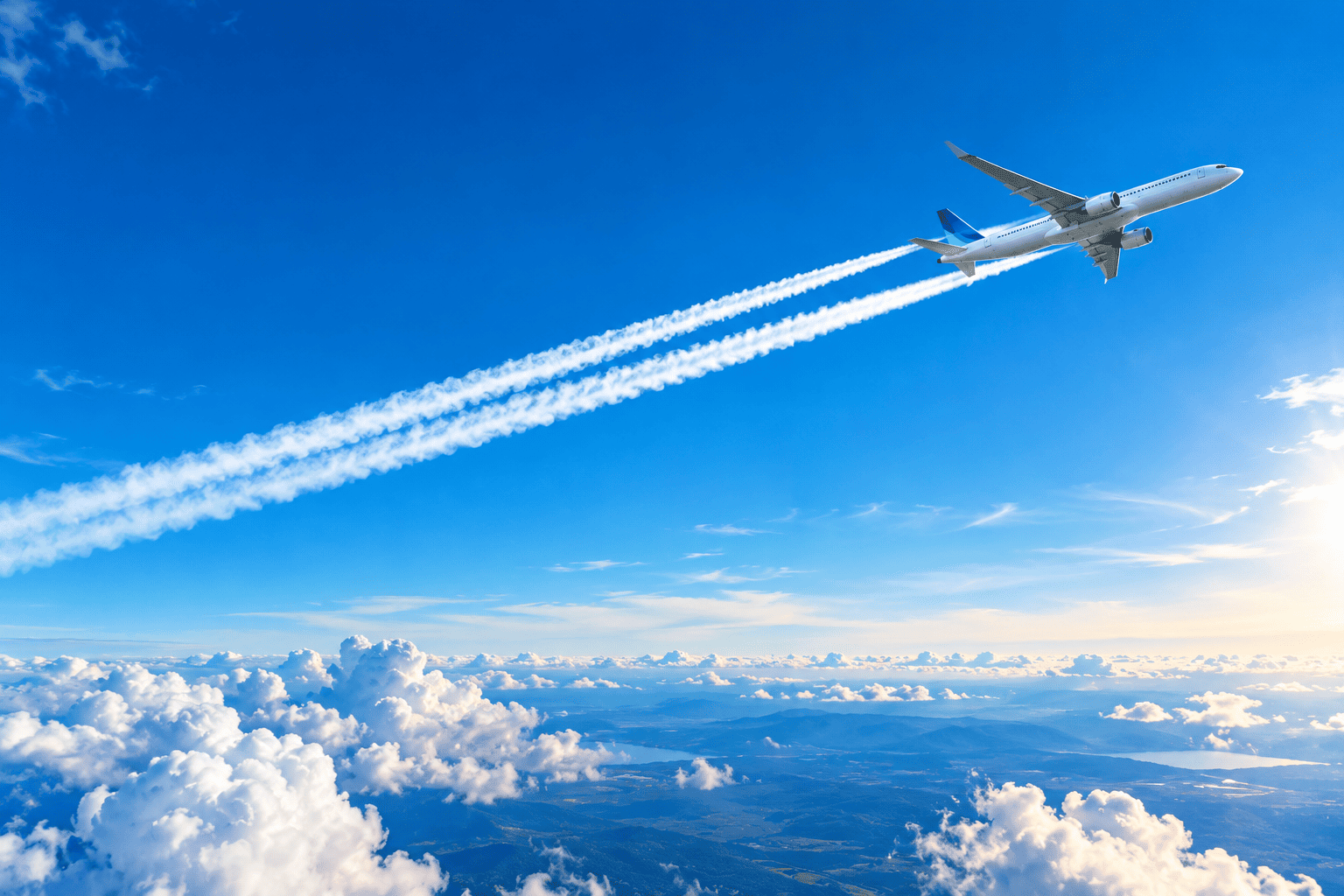
Why Do Airplanes Leave White Trails in the Sky? The Science Explained
Why Do Airplanes Leave White Trails in the Sky? The Science Explained
Have you ever looked up at a clear blue sky and noticed a long, white line stretching behind an airplane? Sometimes the line disappears within seconds. On other days, it remains visible for hours, gradually spreading across the sky.
These white lines are not simply smoke. They are usually condensation trails, commonly known as contrails, formed when aircraft engines release water vapor into very cold air at high altitudes.
Understanding why airplanes leave white trails reveals an interesting connection between aviation, atmospheric science, weather, and climate change.
In this article, we will explore how contrails form, why they sometimes last longer than expected, whether they are dangerous, and what scientists are learning about their environmental effects.
What Are the White Trails Behind Airplanes?
The white trails that appear behind many high-flying aircraft are called contrails. The word is a shortened form of condensation trails.
Contrails are cloud-like formations made primarily of tiny ice crystals. They develop when water vapor in aircraft engine exhaust mixes with the extremely cold air surrounding the airplane.
Although these trails look like long white lines of smoke, their visible appearance comes mainly from ice crystals reflecting and scattering sunlight.
Contrails commonly form at cruising altitudes, where temperatures are extremely low. However, their formation depends on the temperature and moisture content of the surrounding atmosphere, not simply on how high an airplane flies.
According to the Federal Aviation Administration (FAA), contrails form when water vapor condenses and freezes around tiny particles in the atmosphere or aircraft exhaust.
Why Do Airplanes Leave White Trails? How Do Contrails Form?
To understand why airplanes leave white trails, it helps to look at what happens inside a jet engine and in the atmosphere behind the aircraft.
1. Aircraft Engines Produce Water Vapor
Jet engines burn aviation fuel to generate the energy needed to propel an airplane. This combustion produces several substances, including carbon dioxide and water vapor.
The exhaust leaving the engine is hot and contains water vapor. When this warm, moist exhaust mixes with the much colder surrounding air, its temperature drops rapidly.
2. The Water Vapor Condenses
When the exhaust cools, the water vapor can condense onto microscopic particles. These particles may come from the engine exhaust or already be present in the atmosphere.
This process helps form tiny water droplets that can then freeze in the cold air.
3. Tiny Ice Crystals Form
At typical cruising altitudes, the air can be cold enough for the newly formed water droplets to freeze or for ice crystals to form directly under suitable atmospheric conditions.
Millions of microscopic ice crystals can create a visible white trail behind the aircraft.
This is why a trail can appear almost immediately after an airplane passes through the right atmospheric conditions.
4. The Ice Crystals Reflect Sunlight
The ice crystals scatter sunlight in different directions, making the contrail visible from the ground.
The trail appears white because of the way light interacts with the ice crystals. It is not the dark exhaust particles themselves that make the trail look white.
For a more detailed scientific explanation, see NASA’s explanation of aircraft contrails.
Why Do Some Airplane Trails Disappear Quickly?
You may have noticed that some airplane trails vanish almost as soon as they appear, while others remain visible long after the aircraft has moved away.
The main reason is the humidity and temperature of the air at the airplane’s altitude.
When the surrounding air is relatively dry, the ice crystals in a contrail can change directly from ice into water vapor. This process is called sublimation. As the ice crystals disappear, the visible trail fades.
Short-lived contrails may vanish within seconds or minutes.
The exact time depends on the atmospheric conditions. Two airplanes flying along similar routes can leave very different trails if they encounter different layers of air.
Why Do Some Contrails Stay in the Sky for Hours?
Some contrails remain visible for much longer because they form in air that is sufficiently moist with respect to ice.
In these conditions, the ice crystals do not disappear quickly. They may continue to exist, grow, and spread as winds move them through the atmosphere.
Long-lasting contrails can gradually become wider and thinner, eventually resembling natural high-altitude cirrus clouds.
Several factors influence how long a contrail remains visible:
- Humidity: Moist air allows ice crystals to persist for longer.
- Temperature: Very cold conditions support the formation and persistence of ice crystals when sufficient moisture is present.
- Wind: Winds can move the trail away from the aircraft’s original flight path.
- Atmospheric turbulence: Air movement can stretch and spread a contrail.
A persistent contrail does not necessarily mean that the airplane’s engine is malfunctioning. It usually reflects the atmospheric conditions along the flight path.
The UK Met Office’s guide to contrails provides further information about how temperature and humidity affect these trails.
Why Do Airplane Trails Sometimes Spread Across the Sky?
A thin white line can gradually become a broad, wispy cloud. This happens when a persistent contrail spreads under the influence of upper-level winds and atmospheric turbulence.
As the ice crystals disperse, the original straight line becomes less distinct. Over time, the resulting cloud may blend with naturally occurring cirrus clouds.
When many aircraft leave persistent trails in a busy flight region, these trails can overlap or cross each other. From the ground, the sky may appear covered in a network of white lines.
The crossing patterns usually reflect aircraft travelling along different routes, often at different times or altitudes. The trails can also drift after they form, so their current positions may not match the airplanes’ original paths.
NASA has documented how contrails can spread and change appearance in satellite observations. See The Evolution of a Contrail.
Are Airplane White Trails Made of Smoke?
This is a common question because jet engines burn fuel and produce exhaust.
However, an ordinary white contrail is not simply a stream of visible smoke. It is primarily a cloud of ice crystals formed under suitable atmospheric conditions.
Aircraft exhaust does contain combustion products, including gases and small particles. Some of those particles can help ice crystals form, but the white appearance of the trail mainly comes from the ice crystals interacting with sunlight.
It is therefore useful to distinguish between engine exhaust and the visible contrail that may form from it.
Not every aircraft produces a visible contrail at every moment. The same airplane may leave a prominent trail in one part of the sky and no visible trail in another, depending on the temperature and humidity of the air it encounters.
Are Airplane Contrails Dangerous?
Contrails are not the same as a cloud of toxic smoke falling toward the ground. They form high in the atmosphere, and their visible white appearance is mainly caused by ice crystals.
However, that does not mean aviation has no environmental impact.
Aircraft emissions can affect air quality and the climate, while persistent contrails can influence how energy moves through the atmosphere.
It is important to separate these issues: the appearance of a white line alone does not establish that a particular flight is causing a specific health problem.
Do Contrails Affect Climate Change?
Yes. Persistent contrails can influence Earth’s climate.
Like natural high-altitude clouds, contrails can both reflect some incoming sunlight and absorb outgoing infrared radiation from Earth.
Reflecting sunlight can have a cooling effect, while trapping outgoing heat can have a warming effect. The overall impact depends on factors such as the time of day, cloud properties, location, and atmospheric conditions.
Research indicates that persistent contrails have an overall warming effect on climate on average, although the impact varies substantially from one contrail to another.
Not all airplane trails have the same climate effect. Short-lived contrails generally have less influence than trails that persist and spread into extensive cloud cover.
Scientists are studying ways to better predict persistent contrails and reduce their climate impact. The National Academies of Sciences, Engineering, and Medicine provides an accessible overview of this research.
Can Pilots Prevent Airplane Contrails?
Pilots and airlines cannot eliminate contrails in every situation because their formation depends on atmospheric conditions. However, researchers are investigating whether some persistent contrails can be avoided.
One approach is to identify atmospheric regions where contrails are likely to form and, where operationally safe and practical, adjust flight routes or altitudes to avoid them.
Such adjustments must take account of air traffic control, fuel consumption, flight safety, weather, and other operational requirements.
Researchers are also examining aircraft fuels and engine technologies that may reduce the particles that contribute to contrail formation. These approaches are still an area of research and development; they should not be taken to mean that all contrails can already be prevented.
The FAA’s contrails information page explains ongoing work on understanding and addressing persistent contrails.
Why Do Airplane Trails Look Different at Different Times?
Contrails can look different from one flight to another, even when the airplanes appear similar.
Here are a few reasons:
Thin and Short White Lines
These are often short-lived contrails that disappear as the ice crystals sublimate in relatively dry air.
Long, Bright White Lines
These may be persistent contrails that remain visible because the surrounding air is moist enough to support the ice crystals.
Wide, Wispy Cloud-Like Trails
These are often older contrails that have spread under the influence of winds and turbulence.
Trails That Start or Stop Suddenly
An airplane can enter or leave a layer of air where contrail formation is possible. The trail may therefore begin or end abruptly even while the airplane continues flying normally.
White Trails That Look Orange or Pink
Contrails may appear white, gray, orange, pink, or yellow when sunlight reaches them at different angles, particularly around sunrise or sunset. These colors result from lighting conditions rather than necessarily indicating a change in the trail’s composition.
Are All White Lines in the Sky Created by Airplanes?
No. Although many straight, white trails behind high-flying jets are contrails, not every line-shaped cloud in the sky comes from an aircraft.
Natural clouds can form elongated or parallel patterns due to atmospheric waves, winds, and other weather processes. Older contrails may also become difficult to distinguish from natural cirrus clouds after spreading.
There is also a related phenomenon called a wingtip vortex. Aircraft wings create rotating air movements as they generate lift. Under suitable conditions, changes in pressure and temperature within these vortices can produce short-lived visible condensation near the wingtips.
Wingtip condensation is different from the usual engine-related contrail seen behind a jet at cruising altitude.
The appearance of a line in the sky alone is not enough to identify its origin with certainty.
How High Do Airplanes Fly When They Leave Contrails?
Many commercial passenger airplanes cruise at altitudes where the atmosphere is extremely cold, often around 30,000 to 40,000 feet. Contrails commonly form at these high altitudes when the required temperature and moisture conditions are present.
However, there is no single altitude at which all contrails form. Atmospheric conditions vary, and contrails can form at different altitudes depending on the weather.
Altitude alone does not determine whether a trail will appear. The surrounding air’s temperature and humidity are also essential.
Interesting Facts About Airplane White Trails
Here are several useful facts to remember:
- Contrail is short for condensation trail. It describes the cloud-like trail that can form behind an aircraft.
- Contrails are mainly made of ice crystals. Their white appearance comes largely from how those crystals scatter sunlight.
- Some trails disappear quickly. Dry surrounding air can cause ice crystals to sublimate.
- Other trails can persist for hours. Moist atmospheric conditions can allow ice crystals to remain and spread.
- Contrails can move after an airplane passes. Upper-level winds can carry them away from the original flight path.
- Persistent contrails can affect climate. Their influence depends on their properties and the conditions in which they form.
- A visible trail is not evidence of an engine problem. In many cases, it is simply a result of normal engine exhaust interacting with cold, moist air.
Conclusion: Why Do Airplanes Leave White Trails?
So, why do airplanes leave white trails in the sky? The simple answer is that water vapor in aircraft engine exhaust mixes with very cold air, condenses, and forms ice crystals that become visible as a white trail.
These trails are called contrails, and their appearance depends largely on the temperature and moisture content of the atmosphere.
Some disappear within seconds or minutes, while others remain for hours and spread into thin, cloud-like formations. Although contrails are a normal atmospheric phenomenon, persistent ones can also influence Earth’s climate.
The next time you look up and see a white line behind an airplane, you will know that you are observing a small but fascinating interaction between aviation and the atmosphere.
Understanding these everyday phenomena helps us appreciate the science behind the world around us.
Frequently Asked Questions (FAQs)
1. Why do airplanes leave white trails in the sky?
Airplanes leave white trails when water vapor in their engine exhaust mixes with very cold air and forms tiny ice crystals. These visible trails are called condensation trails, or contrails.
2. Are airplane contrails made of water or smoke?
Contrails are primarily made of ice crystals. Aircraft exhaust contains water vapor and other combustion products, but the white trail’s visible appearance comes mainly from the ice crystals rather than from smoke.
3. Why do some airplane trails disappear quickly?
Some contrails disappear quickly because the surrounding air is too dry for the ice crystals to persist. The crystals change directly from ice into water vapor through a process called sublimation.
4. Why do some airplane trails last for hours?
Contrails can last for hours when they form in sufficiently moist air. The ice crystals persist and may spread under the influence of winds and atmospheric turbulence.
5. Do airplane contrails cause climate change?
Persistent contrails can contribute to climate warming because they can trap outgoing infrared radiation. They can also reflect incoming sunlight, which has a cooling effect. Their overall influence depends on atmospheric and lighting conditions.
6. Are airplane white trails harmful to people?
The visible white contrail itself is mainly a high-altitude cloud of ice crystals. However, aviation emissions have environmental impacts, and a trail’s appearance alone cannot establish whether a particular flight presents a specific health risk.
7. Why do airplane trails cross each other?
Airplanes travel along different routes and at different altitudes. Their contrails can cross, overlap, and drift with upper-level winds, creating patterns across the sky.
8. Can airplanes fly without leaving white trails?
Yes. An airplane may not leave a visible contrail when the surrounding atmosphere does not have the right temperature and moisture conditions. A trail can also appear and disappear as the aircraft passes through different atmospheric layers.
9. Are contrails the same as natural clouds?
Contrails are clouds formed because of aircraft activity, whereas natural clouds form through atmospheric processes without an aircraft. Persistent contrails can spread and become difficult to distinguish from natural high-altitude cirrus clouds.
10. Do contrails mean that rain is coming?
Not necessarily. Contrails form under particular conditions at high altitudes, and their presence alone does not reliably predict rain at ground level.
Further Reading and Scientific Sources
For readers who want to learn more about contrails and atmospheric science, these resources provide additional information:
- Federal Aviation Administration (FAA): Contrails
- NASA Earth Observatory: Criss-Crossing Contrails
- UK Met Office: Contrails or Condensation Trails
- National Academies of Sciences, Engineering, and Medicine: Are Contrails Harmful to the Environment?
- NASA Earth Observatory: The Evolution of a Contrail
These sources explain how contrails form, why they persist, and how they can affect the atmosphere.